
Trouble breathing that comes on suddenly, will not ease with rest, or arrives alongside chest pain belongs in the shortness of breath emergency room right now. Call 911 if breathing is severely labored. Plano ER stays open 24 hours a day as a no-wait walk-in ER, and has oxygen, breathing treatments, EKG, chest imaging, and on-site labs ready the moment you arrive. Most patients see a doctor in about 2 to 3 minutes.
Shortness of breath is an emergency when it starts suddenly, happens at rest, comes with chest pain, or leaves you unable to finish a sentence. Blue or gray lips, confusion, or gasping mean call 911. Breathing trouble has too many serious causes to wait out at home.
Feeling winded after climbing a flight of stairs is normal, and so is being out of breath at the end of a hard workout. Feeling winded walking to the kitchen, or waking at night gasping for air, is not. The distinction that matters is whether the breathlessness fits the effort. When it does not, something is interfering with how oxygen moves from the air into your blood, and the list of things that do that includes several conditions that get worse by the hour. Breathlessness is also one of the few symptoms that can come from the lungs, the heart, the blood, or an airway blockage, and the body gives you the same feeling regardless of which one is behind it. That overlap is the reason guessing at home goes wrong so often.
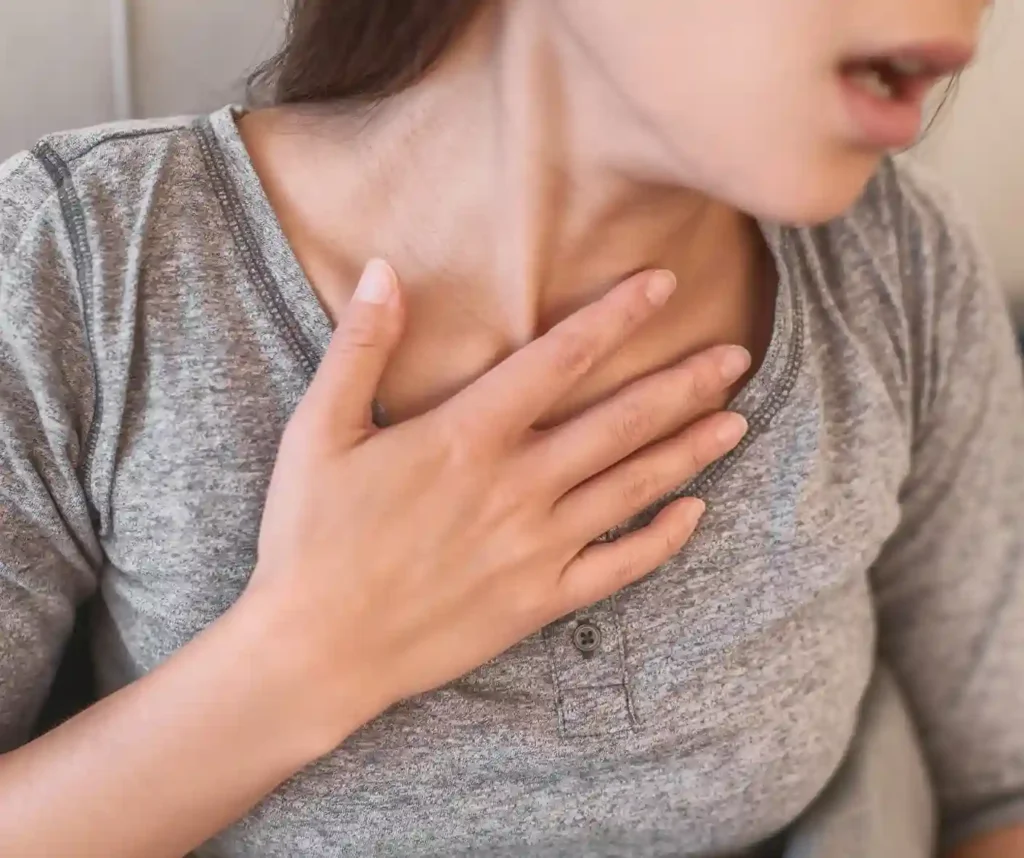
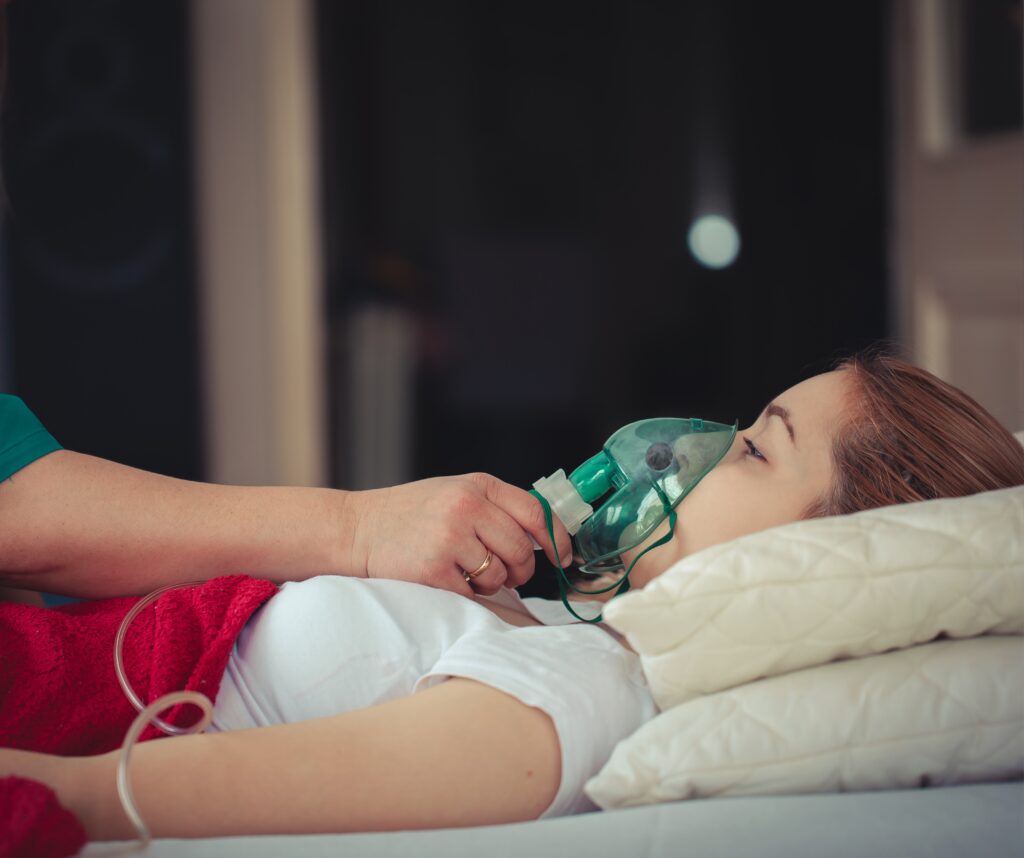
Head to the shortness of breath emergency room, or call 911, when breathing trouble carries any of these signs. Each points toward a cause that needs finding fast.
Anyone with asthma, COPD, or heart failure whose usual home plan is not working should come in rather than keep waiting for it to catch up. If your rescue inhaler is not lasting as long as it used to, or you are using it more often than your plan allows, the flare has already outgrown home treatment.
Sudden difficulty breathing causes fall into a few buckets: the lungs, the heart, a blockage, or a reaction. Asthma flares, pneumonia, a clot in the lung, heart failure, a collapsed lung, and severe allergic reactions all announce themselves the same way, which is exactly why testing sorts them out.
| Cause | What it often looks like |
|---|---|
| Asthma or COPD flare | Wheezing, chest tightness, cough, worse with triggers or exertion |
| Pneumonia or chest infection | Fever, cough with phlegm, chest ache, breathlessness building over days |
| Blood clot in the lung | Sudden breathlessness, sharp chest pain worse with breathing, fast heart rate |
| Heart failure | Breathless lying flat, waking at night to gasp, swollen legs, weight gain |
| Collapsed lung | Sudden sharp chest pain on one side, breathlessness starting in an instant |
| Severe allergic reaction | Throat tightness, swelling, hives, fast onset after a trigger |
| Anxiety or panic | Fast shallow breathing, tingling in hands, chest tightness, no oxygen drop |
Asthma is the most common of these, and our guide to emergency asthma treatment covers what triggers an attack and when a flare has outgrown a rescue inhaler. A reaction that closes the throat is a different emergency, covered under allergic reaction and anaphylaxis care. Anxiety belongs on that list too, and it causes real breathlessness, but panic and a clot in the lung can feel nearly identical from the inside, which is a call for testing rather than self-diagnosis.
Shortness of breath and chest pain occurring together is a cardiac emergency until proven otherwise. That pairing can signal a heart attack, a clot in the lung, or a problem with the aorta. Call 911 or come in immediately rather than waiting to see whether it eases.
The combination raises the stakes because it narrows the list toward the causes with the shortest clock. A heart attack does not always present as crushing chest pain, and in women, older adults, and people with diabetes it often shows up as breathlessness with only mild pressure, nausea, or fatigue. Treating breathlessness plus chest discomfort as cardiac until testing says otherwise is the safe order of operations, and an EKG takes minutes to run.
A clot in the lung deserves its own mention here, since it is the cause people least expect and the one most often missed at home. Recent surgery, a long flight or drive, pregnancy, cancer treatment, or a history of clots all raise the odds, and a clot often pairs breathlessness with sharp pain that stabs when you breathe in. If any of those risk factors apply to you, say so at triage, because it changes what the team looks for first.

At the Plano ER shortness of breath emergency room, breathing trouble is treated as the time-sensitive emergency it is. Because Plano ER is walk-in only, you are roomed at once and most patients meet a board-certified emergency physician in about 2 to 3 minutes. Here is how a typical visit runs.
The team checks your oxygen level, breathing rate, blood pressure, and heart rhythm the second you arrive.
Oxygen therapy starts right away when your levels are low, before the rest of the workup gets going.
Nebulizer treatments open narrowed airways for asthma and COPD flares, often bringing relief within minutes.
For anyone with chest pain, an irregular pulse, or cardiac risk, an EKG runs early to check the heart's electrical activity.
On-site X-ray or CT looks for pneumonia, fluid, a collapsed lung, or signs of a clot, with results read during your visit.
Blood work checks for infection, heart strain, and clotting markers, with results in minutes rather than days.
IV medication, fluids, and continuous monitoring continue while the picture comes together.
Many patients stabilize and go home with a plan and follow-up care.
As a freestanding emergency room, Plano ER is equipped to act fast when breathing is the problem: immediate evaluation, oxygen, breathing treatments, imaging, and stabilization, 24 hours a day. If your condition calls for inpatient or intensive care, we stabilize you first and coordinate a direct transfer to a partner hospital.
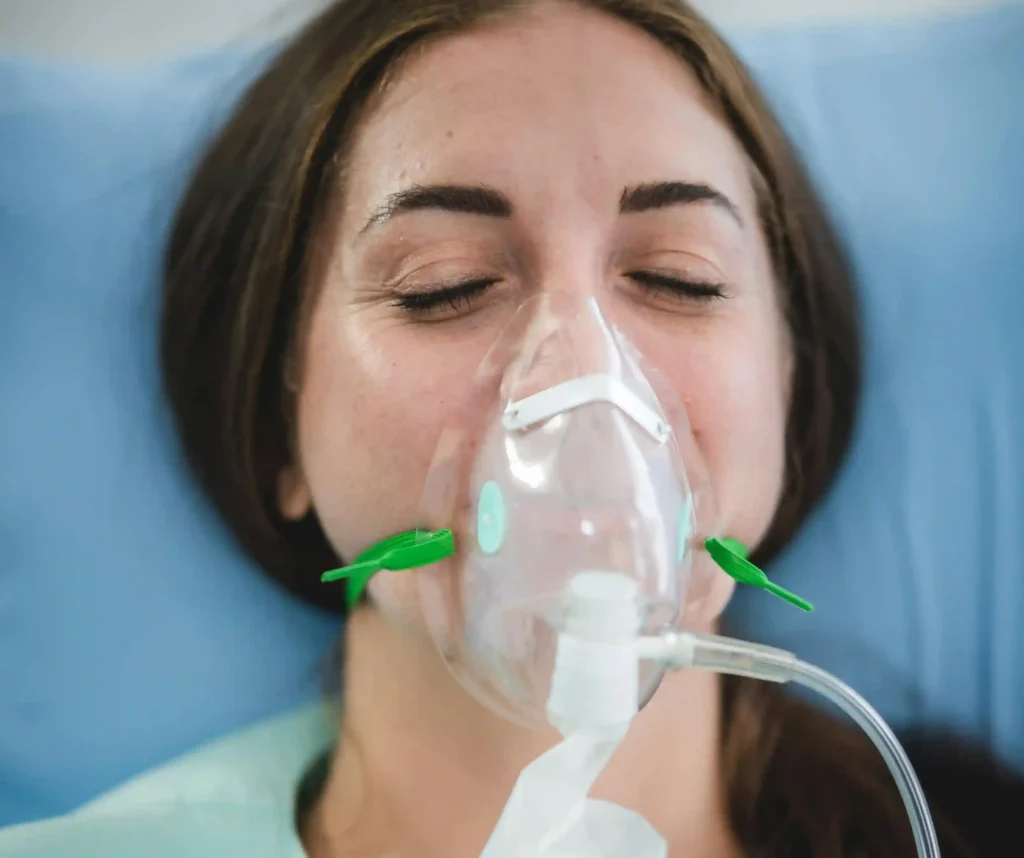
The oxygen treatment emergency room workflow starts with a pulse oximeter, the clip on your fingertip that reads your blood oxygen saturation in seconds. A healthy reading generally sits at 95 percent or above. Anything meaningfully below that, paired with symptoms, means oxygen starts flowing immediately.
Oxygen arrives through a nasal cannula or a mask depending on how much you need. It buys time and comfort, but it is a support, not a cure, so the workup keeps moving underneath it to find the cause. Patients who live with COPD are watched a little differently, since their bodies have adapted to running at a lower baseline. A fingertip reading also has limits worth knowing: cold hands, nail polish, and poor circulation can all throw it off, which is one reason the exam and the labs matter alongside the number.
Some patients have a low oxygen reading with surprisingly little distress, and others feel desperate for air with a normal reading. Both happen, both are real, and neither is dismissed. The number is one input among several rather than the verdict. Your work of breathing, meaning how hard you are laboring to move air, often tells the doctor more than the saturation reading does.
Children compensate well right up until they do not, which makes their breathing trouble deceptive. Watch the ribs and the belly rather than the face. Skin sucking in between the ribs, nostrils flaring with each breath, or a belly working hard to pull air means bring them in now.
Our pediatric emergency team treats asthma flares, croup, RSV, pneumonia, and bronchiolitis across Plano and Collin County. Bring your child in for grunting with each breath, a bark-like cough with noisy breathing, pauses in breathing, blue or gray lips, an inability to speak or feed because of the effort, or unusual limpness and drowsiness. A child too breathless to eat or drink is a child who needs to be seen. Parents are welcome to stay through the entire visit.
Croup has a signature worth knowing, since it tends to strike at night and frightens parents badly. The bark-like cough and the harsh sound on breathing in can improve in cool air on the drive over, then return once the child warms up. That temporary improvement is not a reason to turn around.
As a freestanding emergency room, Plano ER does not balance bill patients, so you are not charged the gap between our billed amount and what your plan pays. Texas law requires freestanding ERs to be clear about billing, and our team works with most major insurance plans, files your claim for you, and reviews your coverage before treatment when possible.
Breathing problems treatment in Plano, TX runs through your insurance, and our billing team explains what is covered before care begins whenever they can. The federal No Surprises Act protects patients from surprise bills for emergency care, so nobody has to check network status while struggling to breathe. For patients without insurance, payment plans are available through Sunbit, and self-pay is welcome. Call ahead and the team can walk you through what to expect.
A few details sharpen the workup, though none should delay you when breathing is labored. If speaking is hard or lips look blue, call 911 and skip the rest.
Our emergency care resource hub covers what to expect across the conditions we treat most often.
It is an emergency when it starts suddenly, happens at rest, comes with chest pain, or stops you finishing a sentence. Blue lips, confusion, or gasping mean call 911 rather than drive.
The shortness of breath emergency room checks your oxygen, starts oxygen therapy if levels are low, gives breathing treatments when they fit, runs an EKG, chest imaging, and on-site labs, then treats the cause it finds.
Sudden difficulty breathing causes include asthma and COPD flares, pneumonia, a clot in the lung, heart failure, a collapsed lung, and severe allergic reactions. Several look alike from the outside, so testing separates them.
Yes, immediately. Shortness of breath and chest pain together is treated as a cardiac emergency until testing proves otherwise, since it can signal a heart attack or a clot in the lung.
Yes, and the breathlessness is real, not imagined. The catch is that panic can feel identical to a clot in the lung, so a first episode or any change in pattern deserves testing rather than assumption.
A pulse oximeter clips to your fingertip and reads blood oxygen in seconds, with healthy readings usually 95 percent or above. Blood work and monitoring add detail when the reading or your symptoms call for it.
Bring them in for skin sucking in between the ribs, flaring nostrils, grunting, a bark-like cough with noisy breathing, blue lips, pauses in breathing, or too much breathlessness to feed or speak.
The shortness of breath emergency room at Plano ER stays open 24 hours a day, takes walk-ins with no appointment, and has oxygen, breathing treatments, EKG, chest imaging, and on-site labs in one building, so relief starts while the cause gets found. We serve Frisco, Allen, McKinney, Richardson, Carrollton, and The Colony from our Plano and Mesquite ER locations. If breathing feels wrong, walk in and let our board-certified physicians sort it out.
Address: 7940 Custer Rd, Plano, TX 75025 | Call: +1 972-527-3000
Related Emergency Conditions
This page is for educational purposes and does not replace emergency medical evaluation. For a life-threatening emergency, call 911.


We are dedicated to providing prompt, attentive, and high-quality emergency medical care delivered by highly qualified, emergency-specialized physicians. Equipped with cutting-edge imaging technology and a certified full-service laboratory, we ensure you receive accurate diagnoses and effective treatment every time.
Disclaimer: All information available on this site is offered for educational purposes and should not be relied upon as medical advice. Viewing this content does not establish any physician–patient relationship. If you are experiencing a medical emergency, dial 911 or seek care at your closest emergency room right away.
Developed by Digital Linkage © 2026 All Rights Reserved